
12 Signs You’re Living in Survival Mode (And How to Slowly Stop)
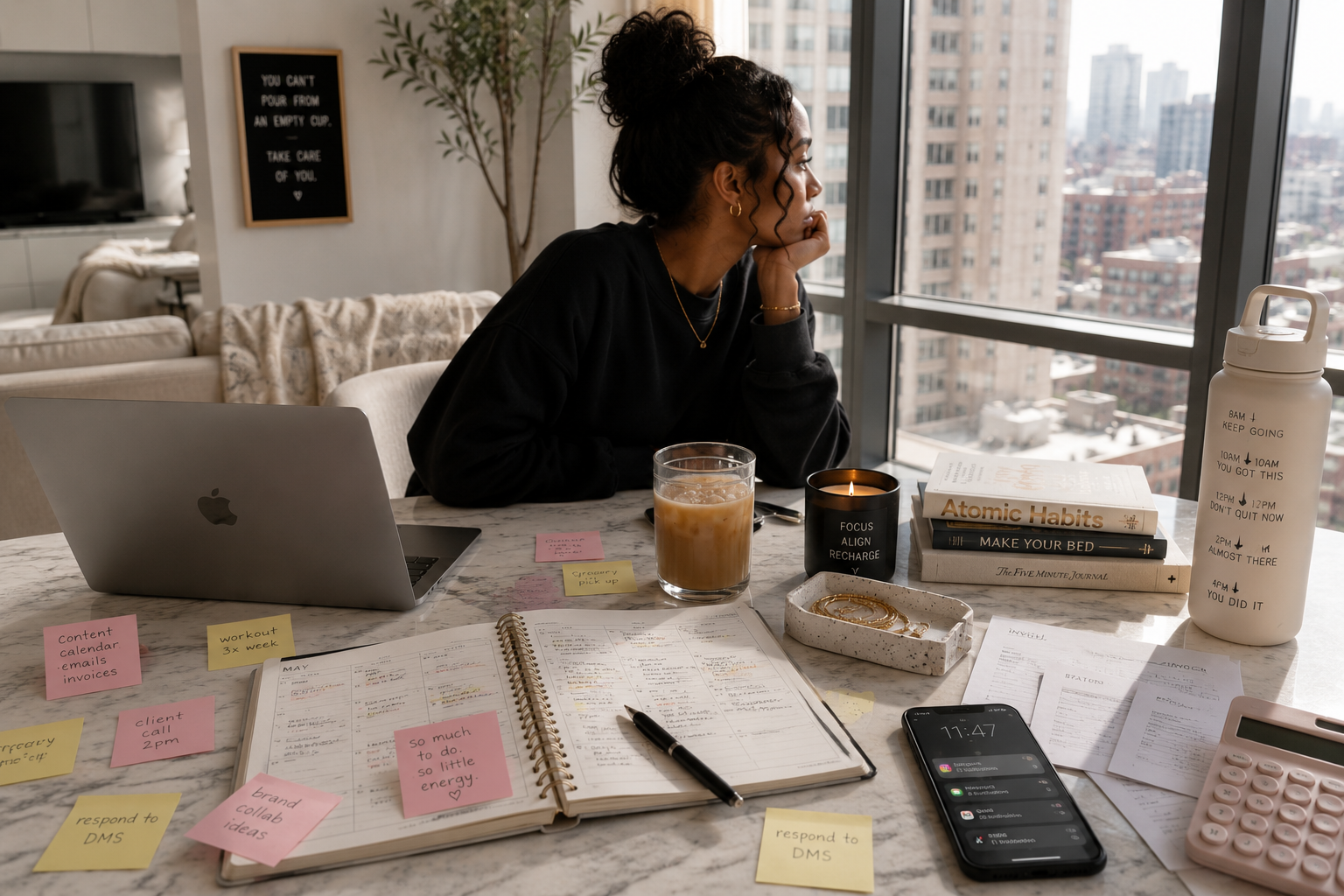
Survival mode does not always look like a crisis. It does not always look like crying on the bathroom floor or calling out of work or being obviously not okay. Sometimes it looks like getting everything done. Meeting every deadline. Showing up for everyone. Being reliable, capable, functional, and completely empty inside.
That is what makes it so hard to catch. Because from the outside you look fine. From the inside you feel like you are running on fumes and one minor inconvenience away from completely losing it. You are not failing at life. You are surviving it. And there is a difference worth naming.
Here are 12 signs you might be in survival mode, why your body does this, and the slow, realistic steps to start coming out of it.
Free · Find out which layer survival mode hit hardest
The Soft Girl Reset Kit™
Survival mode does not hit every area of your life equally. The Reset Kit diagnoses all six layers of your soft life and tells you exactly where to start rebuilding. Free, instant, under ten minutes.
Get the Free Reset Kit →Before the signs
What Survival Mode Actually Is (And Is Not)
Survival mode is not a personality trait and not the same as having a hard day. Those things resolve. Your nervous system returns to baseline. Survival mode is what happens when the stress never stops and your body has been in fight-or-flight for so long it starts treating the stress as the baseline. It stops looking for safety because it has forgotten what safety feels like. It is not weakness. It is not laziness. It is your body doing exactly what it was designed to do: protect you, for so long that it never got the memo that the emergency was over.
The signs
12 Signs You Are Living in Survival Mode
Some of these will hit different. Some might make you stop and sit for a second. That is okay. That is actually good. It means something is landing.
You sleep seven, eight, nine hours and wake up tired. Not sleepy. Tired. The kind of tired that sleep does not touch. That is not a sleep problem. That is your nervous system running on high alert twenty-four hours a day and having nothing left when morning comes.
Someone asks you a simple question and you feel overwhelmed. Your kid spills something and you have to actively hold yourself together. A small inconvenience derails your whole day. That is not overreacting. That is a nervous system with no capacity left. When your cup is already overflowing, one more drop feels like a flood.
The hobbies. The shows. The plans you used to look forward to. They all feel like one more thing you do not have the energy for. This is your body in conservation mode, shutting down non-essential systems to keep you going. Joy feels like a luxury you cannot afford right now.
You make the lunches. You attend the meetings. You reply to the texts. But there is a part of you that is watching from a distance, going through the motions, checked out. This is dissociation, a very real and very common response to chronic stress. Your mind learned to float above the overwhelm to protect itself.
You finally sit down and immediately start thinking about what you should be doing instead. Resting feels irresponsible. Enjoyment feels unearned. You have internalized the belief that your worth is tied to your productivity, and survival mode reinforces this because if you stop moving, it all falls apart.
Skincare? What is that. Body lotion? You cannot remember the last time. Eating actual meals? You are surviving on convenience. When we are in survival mode, physical self-care is always the first thing to go because it feels like the least essential. It is actually the most essential.
You snap. You have a shorter fuse than you used to. You feel resentment toward people you love. You catch yourself thinking things you feel ashamed of. That is not who you are. That is what chronic stress does to a nervous system. Irritability is not a character problem. It is a resource problem.
Not just fine. Not just functional. Actually okay: settled, present, at ease in your own life. If you have to think hard to remember that feeling, that is a sign. When baseline becomes burnout, you forget that anything else is possible.
The clutter has taken over. The surfaces are chaotic. The laundry is in a permanent pile. This is not laziness. This is capacity. When you are running on nothing, your environment reflects it. And the harder part: a chaotic environment makes the survival mode worse. It is a cycle.
You hold it together for everyone else. You are the one people call. You give, you support, you show up. And you do it so consistently that nobody, including you, thinks to check if you are okay. The strong friend role is often a trauma response. Hyper-competence as a way of staying in control when everything feels out of control.
You scroll when you are tired instead of sleeping. You reach for it first thing in the morning before your brain has even booted up. You use it to check out, to numb, to avoid the quiet, because in survival mode quiet feels dangerous. Stillness feels like something is wrong. The phone keeps you from having to be with yourself.
Not because you do not want it. But because you have been in survival mode for so long that ease feels foreign. Peace feels suspicious. Rest feels like it has to be earned. You want the soft life. You just cannot quite believe it is available to you. That disconnection is one of the deepest signs of survival mode there is.
Your nervous system is not broken. It adapted. It learned to keep you alive in conditions that required constant vigilance. The problem is that it forgot to stop.
Why your body does this
The Nervous System Truth
Your nervous system has two modes: regulated and activated. Regulated is the baseline: settled, safe, capable of making decisions. Activated is the stress response: fight, flee, or freeze. It is designed to return to regulation after a threat passes. The problem is that modern life, with its constant demands, the mental load, the financial pressure, the emotional labor, the trauma that never got processed, does not give it a chance to return. The activation just becomes the baseline.
Your nervous system cannot tell the difference between a lion chasing you and a pile of unread emails. Stress is stress. Your body responds the same way. Which means that even when nothing is technically wrong, your body might still be in high alert because it has been in high alert for so long it does not know how to turn it off. This is not a mindset problem. It is a physiology problem. You cannot think your way out of survival mode. You have to work with your nervous system to help it feel safe enough to come down.
A hard season has an end. You go through something brutal and eventually something shifts. Your nervous system was activated and then got to come back down. Chronic survival mode is different. There is no specific crisis, no end point in sight. It is the accumulation of years of too much, too much responsibility and emotional labor and giving with not enough receiving. If you cannot pinpoint what is wrong, if the exhaustion has just become normal, if you have felt this way for so long you thought it was just your personality: that is chronic survival mode. And it requires something different than waiting it out.
The way out
How to Slowly Start Coming Out of It
The key word is slowly. You did not get into survival mode overnight and you are not getting out of it in a week. Any approach that asks you to overhaul your entire life in thirty days is going to put you straight back into the survival mode you were trying to escape. The pressure of a massive transformation is itself a threat to your nervous system. What actually works is small, consistent, gentle, unglamorous, and absolutely revolutionary.
Name it.
Survival mode thrives in denial. The moment you say “I am in survival mode and my body needs help” you have already done something most people never do. You have told the truth. That truth is the starting point of everything.
Lower the bar. Dramatically.
Not “I need to exercise every day.” Try: I need to drink water before my coffee. Not “I need to overhaul my diet.” Try: I need to eat one meal sitting down today. The smaller the starting point, the more sustainable the change. The goal right now is not transformation. The goal is signals of safety to your nervous system.
Create one anchor.
Your nervous system needs consistency to feel safe. One thing, done at the same time, every day, sends a message: this is predictable, I know what comes next, I am not in danger. Pick one thing, a morning anchor, an evening signal, a daily ritual, and make it non-negotiable. Everything else is optional. Consistency in that one thing is the practice.
Reduce the noise.
Survival mode is fed by stimulation. The constant scroll, the news, the group chats, the never-ending email. Your nervous system cannot come down if it is being constantly activated by information it cannot control. You do not have to go off-grid. But you need some protected quiet every day. Even ten minutes.
Tend to your body first.
Water. Sleep. Sunlight. Food. These are not luxuries. These are the foundation your nervous system needs to regulate itself. When you are in survival mode, physical self-care is always the first thing to go. It needs to be the first thing you bring back. Before the journaling, before the meditation, before any of the higher-level healing: the basics.
You are not coming out of survival mode by becoming a different person. You are coming out of it by learning to let your actual self finally rest. The soft life is not on the other side of a perfect routine or a complete overhaul. It is built one small, consistent, gentle choice at a time. Starting today. Starting with the one step that feels the least impossible.
- What it is: a nervous system state caused by chronic, unrelenting stress: not a personality trait, not weakness, not a character flaw.
- The signs: exhaustion sleep cannot fix, small things feeling enormous, lost interest in what you loved, functioning but not present, guilt when resting, self-care gone, irritability that does not feel like you, unable to remember feeling genuinely okay, home reflecting inner chaos, always the strong friend, complicated relationship with your phone, cannot picture the soft life.
- Why your body does this: your nervous system adapted to protect you. Now it has forgotten how to stop. It is physiology, not mindset. You cannot think your way out.
- Hard season vs chronic survival mode: a hard season has an end. Chronic survival mode has no specific cause and no end point in sight. It requires something different than waiting it out.
- How to come out: name it, lower the bar dramatically, create one anchor, reduce the noise, tend to your body first. Small. Consistent. Gentle. Revolutionary.
- Your one thing today: write one honest sentence about how you are actually doing. Not how you are supposed to be. How you actually, really are. That is the beginning.
Build the daily structure that replaces survival mode
Soft Life Blueprint™. Your Values, Your Non-Negotiables, the Daily Rhythm That Holds You
The five steps give you the direction. The Blueprint gives it structure. Your core values written down. Your daily non-negotiables defined so they stop being the first things you abandon under pressure. The morning, the evening, the weekly rhythm built from your real life, not a fantasy version of it. Survival mode stole your daily structure. The Blueprint is how you build it back, slowly, in a way that actually holds.
You have been surviving for a long time. You are really good at it. But there is a version of your life that does not require all of this. A version where you are not just getting through the days but actually living them. It is built one soft, small, consistent choice at a time. Starting with tonight. Starting with one honest sentence.
Renae xx · Founder, Dear Soft Girl
📌 Save this if you have ever wondered why you are always exhausted even when nothing is technically wrong. 12 signs you are living in survival mode, the nervous system truth behind it, and the five slow steps to start coming out of it. This one is for the woman who looks fine from the outside.





Join the List
Stay up to date & receive the latest posts in your inbox.