
Why Financial Peace Is Part of the Soft Life
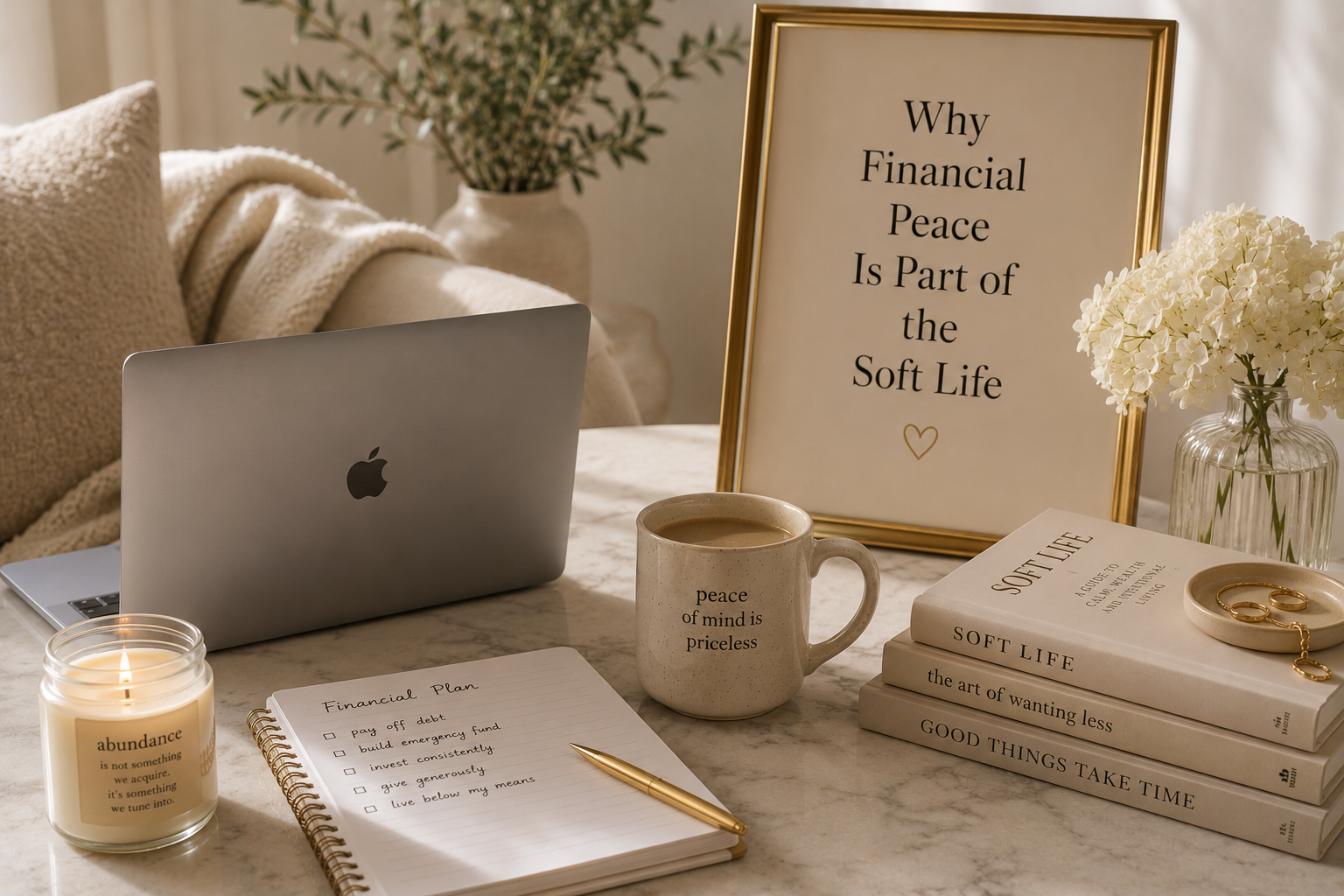
The soft life aesthetic is beautiful. The candles, the linen, the slow mornings, the intentional living. I love all of it. I have built a whole brand around helping women find that softness. But I have noticed something that bothers me about the way it gets talked about online. It is almost always presented as if it is equally available to everyone. As if the only barrier to a soft life is a mindset shift. Just deciding to slow down. Just choosing peace.
But sis, it is really hard to choose peace when your bank account is screaming. Financial stress is one of the most persistent, most physically taxing, most peace-destroying forces in a woman’s life. And yet the soft life conversation almost entirely skips over it. Or worse, implies that if you just had the right mindset, the money stress would not affect you so much. I refuse to do that to you.
The truth is that financial peace is not separate from the soft life. It is one of the foundations of it. And building it slowly, imperfectly, on a real income in a real life, is one of the most genuinely soft things you can do for yourself.
What nobody says plainly
What Financial Anxiety Actually Does to Your Body
When you are financially stressed, your body treats it like a threat. Your cortisol rises. Your nervous system settles into a low-grade state of alert that is not panic, but is not rest either. That state has a name: chronic stress. And it is exhausting in a way that sleep does not always fix, because the source of the stress does not go away when you close your eyes.
Here is what chronic financial stress actually looks like in daily life. Read this slowly and notice what lands.
Not once. Regularly. The quiet of the night is when the math refuses to leave you alone.
Avoidance feels protective. It is not. What you do not look at does not get better on its own.
The purchase feels like agency. Then the guilt arrives and it costs you twice.
Guilt and deprivation are not a financial strategy. They are a loop that keeps you stuck.
When the effort is real but the progress is invisible, that is not a discipline problem. That is a system problem.
If several of those landed: you are not broken. You are not bad with money. You are a woman carrying a genuinely heavy load, doing the best you can with the information and resources you have. And I want to tell you it does not have to stay this loud.
The reset built for women who want financial peace
Soft Girl Money Reset™
Not a budgeting course. Not a shame spiral. A guided six-phase reset that starts with your money pattern, maps your actual paycheck, builds a Soft Budget with guilt-free spending built in, and gives you a plan that fits your real income and your real life. You enter your numbers. It builds your plan. Financial peace is on the other side of clarity, not perfection.
Start My Money Reset ($47) →Why the standard advice doesn’t land
Why Most Financial Advice Does Not Work for Women Like Us
I have consumed a lot of financial content. And so much of it is technically correct and emotionally useless. Make a budget. Build an emergency fund. Stop spending on things you do not need. The implication being that if you are struggling, you have been frivolous. That you made bad choices. That you are not disciplined enough.
The shame built into mainstream financial advice is staggering. And shame does not build wealth. It builds avoidance. When money feels like a source of shame, you stop looking at it. When you stop looking at it, nothing changes. When nothing changes, the anxiety increases. It is a loop, and the entry point of that loop is almost always the emotional component that financial advice refuses to address.
What women like us actually need is not another budgeting spreadsheet. We need a fundamentally different relationship with money. One that starts with honesty instead of judgment, compassion instead of shame, and realistic expectations instead of comparison to a financial ideal that was never built for our income or our lives. You will never budget your way to peace if you have not first addressed the shame that makes you avoid your money in the first place.
Financial peace is not about having a lot of money. It is about having a calm relationship with the money you have. A soft relationship with money means looking at it without dread and spending in alignment with what you actually value. That is buildable from exactly where you are.
What it actually looks like
What a Soft Relationship With Money Feels Like
Not a perfect financial situation. A peaceful one. Here is what it looks like when a woman has found her way to financial peace on a real income in a real life.
The number is information, not a verdict.
Not obsessively. Not anxiously. But she knows what is there. She does not avoid it. She looks at her bank account the way she checks the weather: it tells her what she is working with. It does not tell her what she is worth.
She is not perfect. She is intentional.
She does not deprive herself to hit an arbitrary savings number. But she has a general sense of what matters to her and her money moves in that direction. When she spends on something that aligns with her values she does not feel guilty. When she spends on something that does not, she notices without judgment and adjusts.
Not a twenty-category spreadsheet. Three numbers.
What comes in. What must go out. What is left. That clarity, even a rough version of it, does more for financial peace than any app or system. She knows her numbers and that knowledge is quiet rather than terrifying.
Even small. Even imperfect. Even just beginning.
A savings account with her name on it. A side income she is building. A financial goal that belongs to her. Having something that represents her own agency in her financial life is not a luxury. It is a necessity for a woman who wants peace.
Financial wellness is not linear and she knows it.
Unexpected expenses are part of life, not proof of failure. She does not spiral when the plan falls apart. She adjusts and begins again. That grace is the practice, not the exception.
Financial peace is not about having more. It is about feeling less afraid of what you have.
Where to actually begin
Five Starting Points That Actually Move the Needle
Not a full financial overhaul. Real starting points that shift the relationship, not just the numbers.
Look at it.
Open your banking app. Look at the number. All of them. Do not look away. Just look, without judgment. You cannot build peace with something you are afraid to face. Looking is the first act of courage and it is the only place this actually starts.
Know your three numbers.
What comes in every month. What must go out. What is left. Not twenty categories. Three numbers. Clarity, even rough clarity, reduces anxiety more than any savings balance.
Name the one thing that is loudest.
Is it debt? No savings? Living paycheck to paycheck? Inconsistent income? Name the specific thing causing the most stress. You cannot solve a vague feeling of financial dread. But you can make a plan for one specific thing. Name it and it immediately becomes smaller.
Find one thing that is yours.
Even small. A savings account nobody else touches. A financial goal that is yours and not just the household’s. Having something that represents your own agency in your financial life is not a luxury. It is a necessity.
Talk to it differently.
“I am bad with money” is not a personality trait. It is a story you learned somewhere that you are allowed to unlearn. Start replacing it with honesty: “I am learning to understand my money.” “I am building a better relationship with my finances.” “I am figuring this out.” Small shifts in how you speak about money change how you relate to it over time.
Check in with yourself
Your Financial Peace Self-Assessment
Ten honest statements. Answer yes or no based on where you actually are right now, not where you want to be. This is not a judgment. It is a starting point.
Where is your financial peace right now?
Read each one. Yes means genuinely true for you today. No means not yet.
The FoundationsI know what my monthly income is and approximately where it goes.
I can open my bank account without dread or avoidance.
I have at least a small emergency fund (even $500) that I protect.
Money does not feel like a constant source of anxiety in my daily life.
I make spending decisions intentionally rather than impulsively or from avoidance.
I do not feel shame about where I am financially right now.
I have a financial goal right now, even a small one, that I am actively working toward.
I spend money on at least one thing that is genuinely for my own pleasure without guilt.
I believe financial peace is possible for me, not just for other people.
Money feels like a tool I am learning to use, not something that controls me.
The tool built for this
The Soft Girl Money Reset and Financial Peace
I built the Money Reset because the financial tools that existed were not built for women like us. They were built for people with consistent income, no financial shame, and a working knowledge of budgeting terminology that most of us were never taught. The Money Reset starts somewhere different: with your money pattern. The way you actually relate to money when things get hard.
From there it maps your real paycheck, builds a Soft Budget with three categories including one that is specifically for guilt-free spending on your actual soft life, and gives you a plan for when money gets tight so that a hard month does not undo everything you built in a good one. Financial peace is on the other side of this. Not perfection. Clarity. A plan that actually fits your life.
Six phases. Your paycheck. Your plan.
Soft Girl Money Reset™
Find your money pattern. Map your paycheck. Build a Soft Budget with guilt-free spending built in. Create a cushion. Handle the debt without shame. And build a Sunday check-in ritual so the plan holds week after week. Financial peace is not a personality trait some women have and others do not. It is a practice. This is where you start building it.
Start My Money Reset ($47) →A softer way to hold this
Money Is a Tool, Not a Measure of Your Worth
I want to leave you with a reframe. Because the way most of us were taught to think about money is part of why it feels so heavy. We were taught that money is a measure of worth. That how much you have reflects how hard you worked, how smart you are, how deserving you are. That if you are struggling, it is your fault. That is not the truth. That is a story. And it is a story that keeps women locked in shame instead of action.
Money is a tool. It gives you options and reduces constraints. Having more of it makes certain things easier. Having less makes certain things harder. But it does not tell you anything about your value as a person, your intelligence, or your deservingness of a soft life.
You deserve peace regardless of your bank balance. You deserve softness regardless of your income. And you are capable of building both. The peace and, over time, more financial stability from exactly where you are right now. The soft life is not a destination for when the money is right. It is a practice you build now, with what you have, on your way to more.
- The truth nobody says: it is really hard to choose peace when your bank account is screaming. Financial peace and the soft life are not separate goals.
- What it does to your body: chronic financial stress raises cortisol, disrupts sleep, drives avoidance and impulsive spending. It is a nervous system problem, not just a math problem.
- Why standard advice fails: it is built on shame. Shame creates avoidance. Avoidance keeps you stuck. The loop starts with the emotional component that financial advice refuses to address.
- What a soft money relationship looks like: looking at the number without dread, spending in alignment with your values, knowing your three numbers, having something that is yours.
- Five starting points: look at it, know your three numbers, name the one loudest thing, find one thing that is yours, talk to it differently.
- The reframe: money is a tool, not a measure of your worth. You deserve softness regardless of your income. Financial peace is a practice you build now, with what you have.
Built for real women on real incomes
Soft Girl Money Reset™. Six Phases From Financial Anxiety to Financial Peace
The Money Reset is not a budgeting course and it is not a shame spiral. It is a six-phase guided reset that starts with your money pattern, maps your actual paycheck, builds a Soft Budget with guilt-free spending built in, creates a cushion, addresses debt without judgment, and ends with a Sunday ritual so the plan holds. Financial peace is not a destination you arrive at when you finally earn enough. It is a practice you build from where you are. This is how you start.
Financial peace and the soft life are the same goal. A life that feels less like survival and more like living. You deserve both. And you are capable of building both, starting from exactly where you are right now.
Renae xx · Founder, Dear Soft Girl
📌 Save this for the woman who knows she wants a soft life but cannot find peace while her finances feel out of control. Financial peace is not separate from the soft life. It is one of the foundations of it. This is where to start.

Join the List
Stay up to date & receive the latest posts in your inbox.